


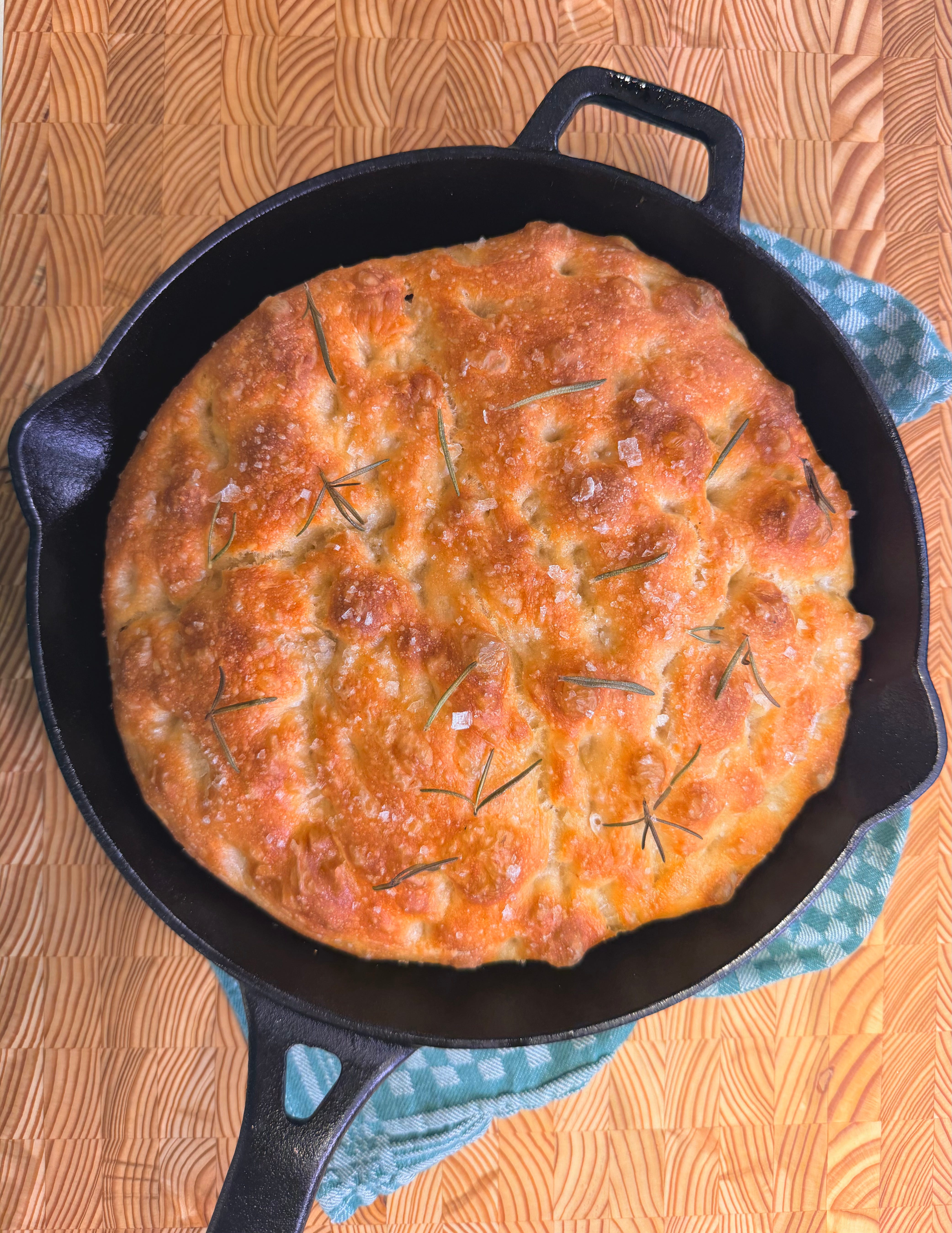
I accidentally developed this focaccia out of sheer laziness, questionable time management, and an inability to follow someone else’s recipe properly.
Most high-hydration focaccia recipes call for a long, slow fermentation. And that’s great and all, but I wanted one I could decide to make in the afternoon and actually eat that night. So I upped the yeast, went for an extremely wet dough, and threw it into a cast iron pan.
The result is big, airy bubbles, a fluffy centre, and an impossibly crisp, olive-oily crust—all in under four hours.
Look, could you make focaccia with a deeper, slightly more fermented flavour if you let it rise overnight? Sure. Will the difference be pretty marginal? Also, yes.
Choose your own adventure here, but as previously mentioned, I often don’t plan ahead. So when I want bread, I want it… immediately.
The dough is intentionally very wet. Don’t panic and add flour. A stand mixer and kneading aren’t necessary here either. This recipe essentially does the work for you—a little mixing at the beginning, a few very gentle folds, and a bit (but not too much) time is all it needs.
Click HERE for recipe video!
Same-Day, No-Knead, Cast Iron Focaccia
Ingredients
For the focaccia:
400 g (3¼ cups) all-purpose flour
360 g (1½ cups) lukewarm water
7 g (1 packet / 2¼ tsp) instant yeast
8 g salt (3 tsp Diamond Crystal kosher salt, 1¾ tsp Morton kosher salt, or about 1½ tsp fine sea salt / table salt)
7 g (1 tsp) honey
54 g (4 Tbsp) extra-virgin olive oil, divided
For the pan & topping:
14 g (1 Tbsp) unsalted butter, softened, for greasing the pan
Flaky sea salt, for finishing
Fresh rosemary or thyme
Extra-virgin olive oil, for serving
A note on measuring: This is a high-hydration dough, so small differences in flour measurements can make a noticeable difference. If you have a kitchen scale, use it! The gram measurements are the most accurate and are the ones I use.
A note on salt! Different types of salt vary in density. That means that a teaspoon of Diamond kosher salt is not the same as a teaspoon of table salt. If you’re using fine sea salt or table salt, don’t substitute it 1:1 by volume with kosher salt. Aim for 8 g by weight, or use the approximate volumes listed above in the ingredients.
Method
1. Mix the dough
In a large bowl, whisk together 400 g (3¼ cups) all-purpose flour, 7 g (1 packet / 2¼ tsp) instant yeast, and 8 g (3 tsp) Diamond Crystal kosher salt (or refer to salt conversion above).
In a measuring cup, stir 7 g (1 tsp) honey into 360 g (1½ cups) lukewarm water until dissolved.
Pour the water mixture into the flour and stir until there are no dry streaks remaining.
The dough will look extremely wet and sticky. That’s exactly what you want.
2. Let it rise
Pour 2 Tbsp of the olive oil into a medium bowl. Transfer the dough to the bowl and turn it over to coat it completely in oil.
Cover tightly and let rise at room temperature for about 2–3 hours, or until the dough is very puffy, jiggly, and full of visible bubbles.
Overnight option: You can also refrigerate the dough for 8–24 hours. Let it come to room temperature before continuing with the recipe.
3. Get it into the pan
Generously grease a 9-inch cast iron pan with 1 Tbsp softened butter, then pour 1 Tbsp olive oil into the centre of the pan.
Using your hands, gently transfer the dough to the prepared pan.
With lightly oiled hands, gently stretch and fold the dough over itself four times, working your way around the dough. Keep everything loose and gentle—you aren’t trying to knead the dough or create a perfectly shaped ball.
Flip the dough seam-side down and leave it in the centre of the pan.
Let it rise, uncovered, in a warm spot for 1–2 hours, or until very puffy and nearly filling the pan.
Tip: Start preheating your oven here! I’ve recently learned that a long preheat helps things bake more evenly, and I usually start preheating 45-60 minutes in advance (if I remember).
4. Dimple & bake
When you’re ready to bake, make sure the oven is preheated to 450°F (230°C) with a rack in the middle position.
Drizzle the remaining 1 Tbsp olive oil over the surface of the dough.
Lightly oil your fingers, then press straight down through the dough until your fingertips reach the bottom of the pan, creating deep dimples across the entire surface.
Sprinkle generously with flaky sea salt and, if you like, fresh rosemary or thyme.
Bake for 25–30 minutes, until the focaccia is deeply golden brown on top and the bottom is crisp and sizzling in the olive oil.
Let it cool for a few minutes before cutting.
Serve with plenty of good extra-virgin olive oil for dipping.
A few tips:
Don’t add flour. I mean it. This dough is supposed to be ridiculously wet. The high hydration is what gives you that light, airy interior.
Don’t overthink the folds. Four gentle folds are plenty. You’re just giving the dough a little structure before it goes into the pan.
Watch the dough, not the clock. Fermentation time will vary depending on the temperature of your kitchen. If your dough isn’t puffy and bubbly after 2½ hours, give it more time. If it’s ready sooner, move on.
And use enough olive oil. The oil in the pan is what gives this focaccia its ridiculously good, crisp, almost fried bottom. If you’re going for a healthy bread recipe, you’ve come to the wrong place.
Liz , your attention to detail and the engaging way you share instructions, made me feel like we were in the kitchen together. Thankyou
Liz, I love your recipe style, it keeps cooking fun. I totally forgot to start my bread the night before (for best result from another recipe) and you saved my son’s birthday dinner. Will definitely make this one again and again - thanks!